Skip to content
personpersonRobert Shawn YaoRobert Shawn YaoTPD forensic supervisor whose assumption-dependent bullet-path opinion favored a shooter near six feet tall; he acknowledged formal trajectory analysis was not possible.← All People
Expert witness

Robert Shawn Yao

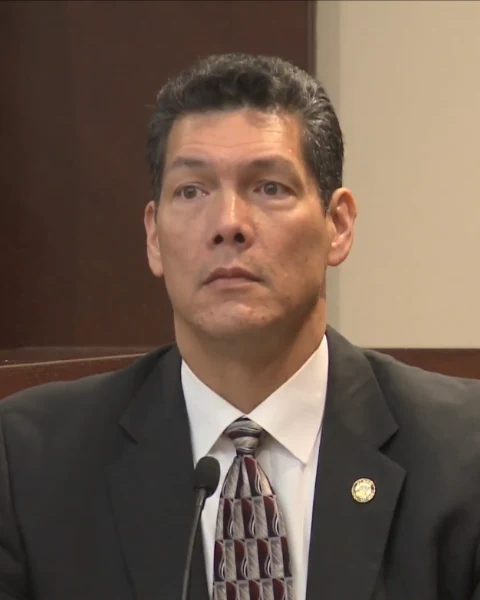
Courtroom still of Robert Shawn Yao.

TPD forensic supervisor whose assumption-dependent bullet-path opinion favored a shooter near six feet tall; he acknowledged formal trajectory analysis was not possible.

86 lines·9 proceedings·4 mentions

About

Called by the State late on Day 1 as a forensic supervisor with roughly 25 combined years at FDLE and the Tallahassee Police Department, Yao was offered on a single narrow question: whether the physical evidence at the Markel shooting scene was more consistent with a taller or a shorter shooter. He described his background in crime scene analysis and bullet-path documentation, distinguished that discipline from full trajectory analysis — a narrower qualification he said he had not previously held — and confirmed he had been at the original scene and had since reviewed the forensic specialist's report, the medical examiner's report, photographs, and sketches. In a proffer taken at the court's direction, he identified the approximately 49-inch height of the entry hole in the driver's-side window and the downward path of the wound as the basis for an opinion favoring a shooter near six feet tall over one around five-foot-four. He also acknowledged that his deposition had treated the window-hole height as consistent with either height. Defense counsel objected, and the court ended the day without ruling, directing that Yao remain for further examination after the jury left and be recalled.

Day 2 opened with two challenges to that opinion outside the jury's presence. Saam Zangeneh argued a discovery violation, contending Yao had updated his opinion and notified only the attorney who had deposed him rather than all defense counsel, leaving the defense without time to retain its own firearms expert. The court found a technical but non-willful violation and denied exclusion, finding no procedural prejudice. Zangeneh separately argued the opinion rested on speculation — unknown decedent body position, firearm angle, firearm height, and shooting stance layered over the single concrete 49-inch datum — and would mislead the jury. The State responded that analyzing a bullet path between two fixed points is well-established methodology with nothing novel in its application. The court overruled the Daubert challenge, finding the methodology not novel and the assumptions a matter for cross-examination.

On direct before the jury, both defense teams waived voir dire and the court accepted Yao as an expert in crime scene analysis and bullet-path documentation. He stated plainly that standard trajectory analysis requires two fixed points and that only a partial window hole was available here, so his opinion rested on stated assumptions: the victim seated upright, the car door closed, and the shooter using a normal standing stance near the door. The observable fact he identified as driving the conclusion was the slight downward declination of the path through Markel — right to left, front to back, slightly downward — which he said a shorter shooter would not produce. He acknowledged he had not seen the medical examiner's report or learned the door-closed status before his first deposition, meaning the developed opinion post-dated that deposition, and testified that the additional review was self-initiated.

Zangeneh's cross concentrated on the single-fixed-point limitation and the unverified inputs. Yao agreed the 49-inch hole alone supports only a five-to-six-foot range with no basis to favor either end, that he could not verify the seated posture, closed door, or trained stance from the physical evidence, that he had not seen a sketch of Markel's position, and that he had not factored the vehicle's seat height into the geometry. He ultimately agreed that a formal trajectory analysis could not be performed from the scene evidence alone. Christopher DeCoste's shorter cross for Magbanua covered the same structure, walking through the two-fixed-points requirement and securing Yao's acknowledgment that, with hard physical evidence missing and the analysis assumption-dependent, he could not state the taller-shooter conclusion with one-hundred-percent certainty; evidence "fitting" a taller shooter, he agreed, is not absolute certainty. The concessions were given directly rather than resisted.

On brief redirect, Georgia Cappleman closed the gap between Yao's in-court demonstration and his deposition language by confirming that fully extended and slightly bent arms both fall within the normal stance he assumed, leaving the height opinion unchanged. She then elicited that the sideways "gangster-style" hold raised on cross decreases bullet accuracy, immediately followed by confirmation that Markel was shot between the eyes. Yao was kept under the rule of sequestration at the State's request, Zangeneh declined to request recall, and no juror questions were taken. The opinion's function in the case was as the State's physical-evidence basis for distinguishing which of the two men at the scene fired the shot, tying trajectory to the identity element of the first-degree murder charge.

Yao's name recurred in the record after he stepped down. On a later day, defense counsel raised a sequestration issue, describing an officer approaching the prosecutors with a piece of paper during Yao's testimony and moving to strike; the objections were ruled on and expressly preserved, with the court noting that any disagreement would be resolved on appeal. He was also referenced during examination of another witness about pre-trial communications and about whether he had reviewed the photographs and report at the time of an office visit roughly two weeks earlier.

Trial Record (9)

GMGarcia–MagbanuaSep 26, 2019 – Oct 11, 2019Called by prosecution

Testified as the Tallahassee Police Department forensic supervisor who offered an assumption-dependent bullet-path opinion favoring a shooter near six feet tall while acknowledging that formal trajectory analysis was not possible; the opinion was admitted over discovery and Daubert objections and tested across two cross-examinations on Day 2.

Day 1

DirectRobert Shawn YaoGeorgia Cappleman4highlights20lines spoken

Summary

TPD Forensic Supervisor Robert Shawn Yao described his crime-scene and bullet-path background, then proffered an opinion that the physical evidence was more consistent with a taller shooter. After Zangeneh objected, Judge Hankinson directed further examination at day's end before Yao was recalled.

Highlights (4)

testimony highlightYao proffered his refined opinion — based on the ~49-inch window hole height, comparative shoulder heights, and a downward wound path from left cheek to behind the left ear — that the physical evidence is more consistent with a shooter approximately six feet tall than with someone around five-foot-four, acknowledging this refines his prior deposition testimony.Open in transcript →Watch this moment ▶
Quote“During the deposition, I testified that based upon the height of the projectile hole in the window, that it would be consistent with both a short as well as a tall shooter.”— Robert Shawn YaoYao identifies his earlier deposition position — that the window-hole height was consistent with either a short or tall shooter — before explaining the additional assumptions behind his current opinion.Open in transcript →Watch this moment ▶
Quote“So because of the downward angle, if you assume that the person is sitting upright at the time the shot was fired, connected to the hole in the window, it is more consistent with somebody being taller firing at a downward angle into the passenger compartment, rather than a shorter person firing it where it would be almost parallel.”— Robert Shawn YaoYao explains why, under his stated assumptions, he considered the wound and window-hole angles more consistent with a taller shooter.Open in transcript →Watch this moment ▶
rulingAfter defense counsel Zangeneh objected to Yao's shooter-height opinion, Judge Hankinson ordered another witness called and directed that Yao remain until the end of the day for further examination after the jury left, followed by a recall.Open in transcript →Watch this moment ▶
CrossAnthony ClarkMauricio PadillaMentioned

Summary

Padilla's cross of medical examiner Clark drew out that TPD forensic supervisor Shawn Yao visited Clark's office and called him by phone just weeks before trial to discuss wound trajectories — at a time when Yao had not yet read the autopsy report finalized five years earlier.

Mentioned in this proceeding.

Day 2

ProceduralYao Daubert Ruling and Rivera-Attorney Depositions4highlightsMentioned

Summary

Court denied Garcia's motion to exclude Investigator Yao's bullet trajectory opinion, overruled a Daubert challenge to its methodology, then addressed the State's late addition of Rivera's attorneys as witnesses — ordering depositions before they could testify; Magbanua's team renewed its motion to sever.

Mentioned · TPD forensic supervisor whose updated bullet trajectory opinion was the subject of both the discovery motion and the Daubert challenge.

Highlights (4)

Quote“he is gearing towards making an assessment that the purported shooter — that the shooter in this case — was at least six feet tall, or around six feet tall. My client fits that description, whereas Luis Rivera is substantially shorter, and the inference that he would give would suggest that if there were two people that were involved in this shooting, and one was around the height of my client and one was around the height of Luis Rivera, that my client is in fact the shooter.”— Saam ZangenehZangeneh states plainly the strategic stakes of Yao's trajectory opinion: the height inference points directly to Garcia as the shooter and away from Rivera, giving the jury a physical basis to assign the triggerman role to his client.Open in transcript →Watch this moment ▶
rulingCourt denied Garcia's motion to exclude Investigator Yao's trajectory testimony, finding a technical but non-willful discovery violation insufficient to warrant exclusion and concluding the defense was not procedurally prejudiced.Open in transcript →Watch this moment ▶
Quote“He also went on to say that he doesn't know if the shooter was shooting — and his own words were — gangster style. Our position is that Luis Rivera is a gang member and potentially shoots gangster style.”— Saam ZangenehZangeneh openly characterizes Rivera as a gang member who may have fired in an atypical stance, directly attacking the reliability of Yao's height inference and the State's theory that Garcia was the triggerman.Open in transcript →Watch this moment ▶
rulingCourt overruled Garcia's Daubert challenge to Yao's bullet trajectory methodology, ruling the science not novel, the assumptions understandable, and any confusion addressable through cross-examination.Open in transcript →Watch this moment ▶
DirectRobert Shawn YaoGeorgia Cappleman7highlights19lines spoken

Summary

TPD forensic supervisor Robert Shawn Yao resumed direct examination and was accepted as an expert in crime scene analysis and bullet path documentation without voir dire challenge from either defense team. He testified that a downward bullet declination through Markel is more consistent with a six-foot-one shooter than a five-foot-four shooter, based on window hole height, wound documentation, and stated assumptions about victim position and door status.

Highlights (7)

procedural actionCappleman tendered Yao as an expert in crime scene analysis and bullet path documentation; both Garcia's and Magbanua's counsel declined voir dire and the court accepted him, allowing the full trajectory opinion to proceed without qualification challenge before the jury.Open in transcript →Watch this moment ▶
Quote“I did it on my own.”— Robert Shawn YaoYao volunteered that his post-deposition review of the ME report and crime scene sketches was self-initiated, not prosecution-directed — lending independence to the taller-shooter opinion he then delivered.Open in transcript →Watch this moment ▶
Quote“it was my opinion that using those assumptions, that it was more consistent with a taller shooter rather than a shorter shooter”— Robert Shawn YaoThe core expert conclusion the prosecution's trajectory examination built toward — that the physical evidence, under stated assumptions, points to a taller shooter.Open in transcript →Watch this moment ▶
Show all 7 highlights
testimony highlightYao explained the full scientific framework: the need for two fixed trajectory points, the limitation of only a partial window hole, the 49-inch hole height, comparative shoulder heights of a six-foot versus five-foot-four shooter, and the slight downward declination — concluding that the evidence is more consistent with the taller suspect.Open in transcript →Watch this moment ▶
Quote“In this case there is declination, which is more indicative of somebody being taller and aiming downward toward the victim from outside the car.”— Robert Shawn YaoThe observable physical fact driving the taller-shooter opinion: the downward bullet path through Markel distinguishes the two height hypotheses because a shorter shooter would have produced a more horizontal trajectory.Open in transcript →Watch this moment ▶
testimony highlightCappleman directly posed the two suspects' heights — approximately five-four and six-one — and asked whether the evidence is more consistent with the taller individual; Yao confirmed yes, delivering the prosecution's clearest formulation of the opinion.Open in transcript →Watch this moment ▶
CrossRobert Shawn YaoSaam Zangeneh6highlights31lines spoken

Summary

Garcia's lead counsel methodically extracted admissions from TPD forensic supervisor Robert Shawn Yao that his shooter-height opinion rested on unverifiable assumptions and that, by his own account, a formal trajectory analysis cannot be performed from the single fixed point available.

Highlights (6)

admissionZangeneh confirmed that using only the single available data point — the 49-inch window entry hole — Yao's prior deposition range placed the shooter between five and six feet tall, with no physical basis to favor either end of the range.Open in transcript →Watch this moment ▶
admissionYao admitted he had not seen a sketch of the victim's position at the time of the shooting and did not account for the vehicle seat height — two unverified variables his opinion required to reach the taller-shooter conclusion.Open in transcript →Watch this moment ▶
admissionWhen asked directly whether an accurate shooter-height opinion was possible without knowing the victim's position, Yao answered no, then agreed with Zangeneh's summary that the analysis cannot be performed from the physical evidence alone.Open in transcript →Watch this moment ▶
Quote“What I can say is there is no ability to do a trajectory analysis based solely upon the physical evidence that's found at the scene, because it's only a singular hole without a connecting point. So the answer is no.”— Robert Shawn YaoYao's own words establish that a formal trajectory analysis cannot be performed from the available physical evidence, directly undercutting the opinion he offered on direct examination that the evidence was more consistent with a taller shooter.Open in transcript →Watch this moment ▶
Show all 6 highlights
Quote“Any alteration may cause slight deviations in the consistency of my opinion. The more variations, the more discrepancy or deviations you'll see.”— Robert Shawn YaoYao concedes that each of his three key assumptions — victim sitting upright, door closed, normal shooting stance — is independently capable of undermining his opinion, compounding the earlier admission that the analysis cannot be formally performed.Open in transcript →Watch this moment ▶
procedural actionJudge Hankinson allowed Yao to stand and physically demonstrate a normal shooting stance before the jury — arm extended, weapon angled down toward a sight picture — illustrating the geometric assumptions underlying his height opinion.Open in transcript →Watch this moment ▶
CrossRobert Shawn YaoChristopher DeCoste2highlights10lines spoken

Summary

Magbanua co-counsel DeCoste conducted a brief cross eliciting that Yao's shooter-height opinion rests on assumptions and could not be stated with one-hundred-percent certainty given the missing physical evidence.

Highlights (2)

admissionYao admitted that missing physical evidence and reliance on multiple assumptions prevent him from stating with 100 percent certainty that the shooter was taller, and agreed that the evidence 'fitting' a taller profile does not amount to certainty.Open in transcript →Watch this moment ▶
Quote“Well, I don't have sufficient information, because — and the thing is, with forensic science or any kind of analysis, it requires hard evidence, or physical evidence to be present. And in this case, in order to be 100% sure to do the analysis, there are missing points and we're using a lot of assumptions.”— Robert Shawn YaoYao's clearest on-record acknowledgment that his shooter-height opinion depends on missing physical evidence and multiple unverified assumptions, directly undercutting the weight a jury might assign to his expert conclusion.Open in transcript →Watch this moment ▶
RedirectRobert Shawn YaoGeorgia Cappleman2highlights6lines spoken

Summary

Cappleman rehabilitated Yao's shooter-height opinion on redirect by clarifying that arm-bend variation does not undermine the taller-shooter inference and by using the shot's documented precision — between the eyes — to undercut the gangster-style stance alternative raised on cross.

Highlights (2)

testimony highlightCappleman established that gangster-style shooting decreases accuracy, then immediately contrasted that with Yao's confirmation that the fatal shot — between the eyes — was precise, constructing an implicit argument that the accurate placement is inconsistent with the low-accuracy sideways hold the defense raised on cross.Open in transcript →Watch this moment ▶
Quote“When Mr. Markel received it right between the eyes — that's a pretty accurate shot.”— Georgia CapplemanCappleman juxtaposed the placement of the fatal shot with Yao's testimony that the sideways stance raised on cross decreases accuracy.Open in transcript →Watch this moment ▶

Day 3

ProceduralRivera-Attorney Privilege and Brannon Sequestration Issues4highlightsMentioned

Summary

Defense challenges Rivera's attorneys for asserting privilege at deposition while claiming no recollection; court reserves ruling and orders them to appear the next morning. Officer Brannon's sequestration violation — passing prosecutors a note during Yao's testimony about shooting accuracy — leads to a denied motion to strike, with Brannon's future testimony limited to Wendi Adelson's approach to the crime scene.

Mentioned in this proceeding.

Highlights (4)

evidence eventJudge questions Cappleman about the note Brannon passed to prosecutors during Yao's testimony; Cappleman confirms it stated that 'gangster style' shooting is less accurate than traditional — the same subject area explored with Yao.Open in transcript →Watch this moment ▶
Quote“It was that the gangster style of shooting would be less accurate than traditional.”— Georgia CapplemanCappleman discloses the content of Brannon's note to the court — the specific tip that triggered the sequestration objection and that defense alleged was used to shape Yao's testimony.Open in transcript →Watch this moment ▶
Quote“I'm not going to let him do that. I'm not going to let him testify on anything that relates to what Yao was testifying to. But the question is whether his testimony about what he was going to testify to — seeing Ms. Adelson at the crime scene — whether that's tainted by the fact he was in the area during Mr. Yao's testimony.”— James C. HankinsonThe court draws the line that limits Brannon's scope at trial and frames the narrow question actually before it under the sequestration rule.Open in transcript →Watch this moment ▶
rulingCourt denies DeCoste's motion to strike the relevant portion of Yao's testimony with a curative instruction, denies any motion to exclude Brannon, and limits Brannon's future testimony to his observation of Wendi Adelson at the crime scene tape — expressly barring any overlap with Yao's subject matter.Open in transcript →Watch this moment ▶

Day 10

ClosingClosing Argument - Saam ZangenehMentioned

Summary

Garcia's lead counsel Saam Zangeneh delivered a systematic credibility attack on Luis Rivera using a 'house inspection' metaphor, argued Rivera was the actual shooter, and told jurors the evidence pointed more substantially at the uncharged Adelson family than at Garcia.

Mentioned in this proceeding.