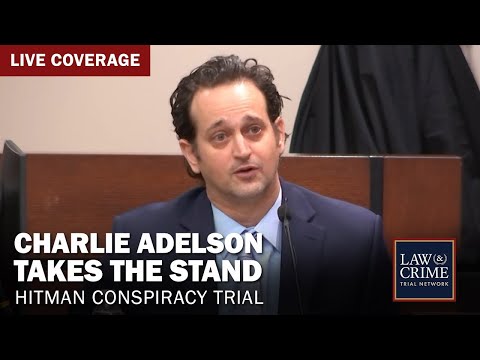
Day 7 - November 3, 2023
Charlie Adelson finished direct examination, faced cross-examination by the prosecution, and completed redirect before the defense formally rested. The state declined rebuttal, closing the evidentiary record. In an afternoon charge conference, Judge Everett finalized jury instructions for all three counts over one contested ruling.
Full day summary
5:31:51 1. Charlie Adelson — Direct/Cross/Redirect
Day 7 opens with the conclusion of Charlie Adelson's direct examination, followed by Georgia Cappleman's cross-examination, a short recess, and Dan Rashbaum's redirect — completing Charlie Adelson's testimony.
Highlights
Charlie Adelson - Direct (Continued) “I would have been killed. There was — I, I didn't want to tell anybody, because they would have come after my family.” — Charlie Adelson Charlie's direct answer to why he never went to police despite knowing more about the murder than law enforcement — the defense's central explanation for 20-plus months of silence, which the prosecution contests as consciousness of guilt. Charlie Adelson - Direct (Continued) procedural action Rashbaum poses each charged count individually — murder, principal, conspiracy, solicitation — and Charlie answers 'Absolutely not' or 'Never' to each, formally closing his direct examination. Charlie Adelson - Direct (Continued) “Absolutely not.” — Charlie Adelson Charlie's answer to Rashbaum's direct question — 'Did you have anything to do with the murder of Professor Dan Markel?' — the most formally significant single exchange in the defendant's entire direct examination. Charlie Adelson - Cross confrontation Cappleman reveals Charlie used the word 'extortion' 123 times on direct examination, then presses that the alleged layer-one extortion appears nowhere on hundreds of hours of wire recordings. The only mention, Charlie admits, was a whisper into Harvey's ear at Matsuri — intentionally inaudible to surveillance. Cappleman: 'But it sucks for your defense, right? Because that would be a huge piece of evidence for you to show this jury.' Charlie: 'No, I think you'd come up with a reason why I said it anyway.' Charlie Adelson - Cross “If you're going to quote me, date me. Like, what I knew in 2014 and what I knew in 2015 is not what I know now in 2023.” — Charlie Adelson Charlie's most articulate formulation of his core defense against behavioral evidence: each act must be judged against his contemporaneous knowledge, not 2023 hindsight. Cappleman refuses to accept this as a shield and continues pressing the 2014 affectionate texts as incompatible with victimhood regardless of the temporal frame. Charlie Adelson - Cross ruling Judge Everett intervenes during the Dolce Vita clip examination to direct that the parties not speak over each other and to instruct Charlie specifically to answer the question asked before elaborating. The ruling reflects escalating friction as Charlie resists Cappleman's efforts to confine him to yes-or-no answers. Charlie Adelson - Cross confrontation Cappleman closes cross asking whether Charlie was not merely someone who knew a big piece of what happened, but 'a big piece of it' himself. Charlie's final answer — 'I was extorted, and I knew a lot, yeah' — concedes knowledge while stopping short of a clear denial, leaving the jury with an ambiguous closing statement. Charlie Adelson - Cross “And that's because you didn't just know a big piece of it. You were a big piece of it, weren't you, Doctor?” — Georgia Cappleman Cappleman's final question before ending cross distills the prosecution's theory in its starkest form. Charlie's response — 'I was extorted, and I knew a lot, yeah' — falls short of a flat denial and serves as the prosecution's closing capstone. Charlie Adelson - Redirect “The reason I didn't pay it all off is because it became like a life insurance policy. And I felt like every month when I paid, I felt like they weren't going to kill me, because if they killed me, they wouldn't get the money next month.” — Charlie Adelson First appearance of the 'life insurance policy' metaphor in testimony; offers a coherent extortion-victim rationale for the installment payment structure that the prosecution characterized as hitman-fee payments spread over 20 months. Charlie Adelson - Redirect “If I don't tell everyone what happened now, I'm going to spend the rest of my life in prison for something I didn't do.” — Charlie Adelson Charlie's closing appeal to the jury, framing his decision to testify as compelled by necessity rather than prior willingness — a strategic final note designed to reframe cross-examination questions about why he had not spoken sooner. Charlie Adelson - Cross confrontation Cappleman opens cross with Occam's Razor — the simplest explanation is usually correct — and presses Charlie on whether his daylong testimony constituted the simplest explanation. Charlie replies: 'It was the truth.' The exchange establishes the prosecution's evaluative frame for the entire cross. Charlie Adelson - Cross “Have you ever heard the saying that the simplest explanation is always the most likely?” — Georgia Cappleman Cappleman's opening frame for the entire cross: Charlie's elaborate multi-layered extortion narrative is implicitly contrasted with the prosecution's simpler theory. The question sets an evaluative expectation that every subsequent verbose explanation will be weighed against parsimony.
3. Charge Conference — Jury Instructions Finalized for All Three Counts
Afternoon charge conference in which Judge Everett finalized jury instructions for all three counts ahead of Monday closing arguments.
Highlights
Charge Conference — Jury Instructions Finalized for All Three Counts procedural action Both parties waived all lesser included offenses on the murder count on the record, and the defense conceded the homicide was neither excusable nor justified, producing a binary guilty/not guilty verdict form with no intermediate options. Charge Conference — Jury Instructions Finalized for All Three Counts ruling Judge Everett overruled the defense objection and added a standalone intent definition (Standard Instruction 13.1) to the jury instructions, citing Butler v. State, over defense counsel's argument that the instruction was unnecessary and had not appeared in the prior trial.