Direct examination of digital-forensics and records-custodian witnesses, structured as credentials, technology primer, chain of custody, exhibit authentication, then the probative contact-name entry.
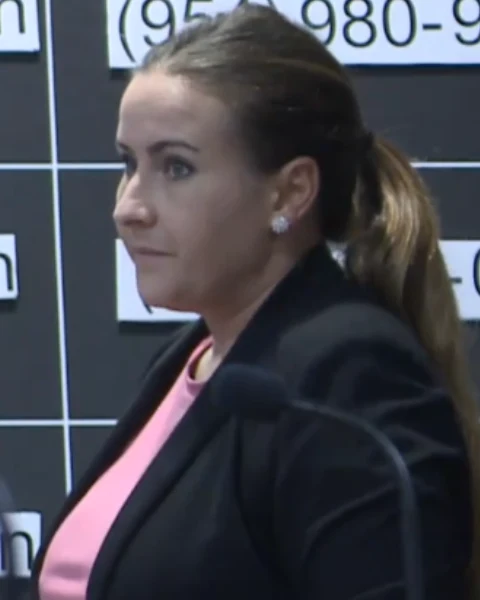
Anna Norris

Second-chair prosecutor who presented much of the State’s digital-forensics, cell-site, wiretap, and financial-record evidence through direct, redirect, and rebuttal.
About
Appearing as second chair for the State and addressed on the record as "Ms. Norris," Anna Norris carried the technical and documentary side of the prosecution's case-in-chief. She examined the digital-forensics and records witnesses in her own right, beginning on the first trial day with the direct examination of a Tallahassee Police Department digital-forensics examiner — credentials, a cloud-technology primer for the jury, chain-of-custody foundation, and exhibit authentication, with the "Kaddie" contact-name entry reserved for the close — and a short redirect establishing that investigators divided the digital-review tasks. On the second day she took a T-Mobile records custodian through authentication and secured admission of the tower-dump disc without cross-examination.
Her largest assignment was the cell-site and phone-records testimony of a TPD technical-operations sergeant, whom she examined on direct, redirect, and recall across five separate trial days. She built the examination around demonstrative maps drawn from previously admitted call-detail records, rental GPS, SunPass tolls, hotel and bank records, and surveillance video, anchoring each location claim to evidence already in the record. The recall direct traced the June scouting trip and the July trip in chronological sequence and closed with a minute-by-minute communication log spanning the night before and the morning of the shooting. On a later day she laid the wiretap foundation — judicial authorization, monitoring and minimization procedure, the three intercepted handsets, and chain of custody for the recordings — before the recorded calls were played, and on redirect framed minimization as a court-ordered mandate rather than an investigative choice and explained that intercepts capture only prospective communications, so the 2014 calls preceding the murder could not be retrieved. Later redirect work corrected a time-zone discrepancy in the defense's own Sprint exhibits, addressed the three unconnected calls from Magbanua's handset to a number identified as Rivera's older line, and introduced a reformatted version of an iCloud exchange the defense had displayed as State's Exhibit 183. She recalled the same witness on rebuttal to introduce four blocks of iCloud messages and the Eco-Friendly Auto mechanic chronology.
Norris also presented the State's financial case through a certified fraud examiner, covering the bank, credit-card, investment, employment, and DMV records reviewed for Garcia, Rivera, Magbanua, and the Adelson family; post-murder vehicle purchases; the change in Rivera's withdrawal and overdraft pattern beginning two days before the murder; the untraced cash portion of a surgical bill; the Adelson Institute payroll records and what the subpoena response did not contain; and the cash-deposit totals across 2013–2016. She recalled that witness later to introduce income-tax returns and to publish demonstrative comparisons of reported wages against cash deposits, and conducted a brief redirect on two bounced nightclub checks.
She appeared in argument and objection as well as examination. She opposed six proposed defense exhibits as self-serving hearsay, objected under Rule 403 to defense use of an April 2014 iCloud exchange (overruled on open-the-door grounds), and offered an iCloud text on a non-hearsay theory — circumstantial evidence of when identifying information was transmitted rather than proof of its contents. Rulings ran both ways: several of her questions drew sustained objections, including questions about the reason for a vehicle swap, bolstering questions about the cell-site witness's confidence, an opinion question about one-directional financial support, and a closing question on the dental-appointment recontextualization; three speculation and province-of-the-jury objections to her iCloud questioning were overruled, as was a hypothetical posed to the financial expert about nightclub earnings. The presiding judge repeatedly directed her on the record to speak up, re-ask questions, identify who was calling or texting whom, and move on, and treated a question about the legal grounds for a wiretap as a matter for the court rather than the witness. Opposing counsel moved for sanctions over the timing of a discovery issue and an exhibit received from her; a Richardson request over newly handed documents was denied.
Attorney insights (14)
Garcia–Magbanua77
Cell-site and phone-records presentation built on demonstrative maps anchored to previously admitted call-detail records, rental GPS, tolls, bank records, and surveillance video.
Supporting record (2)
Wiretap foundation before playback: judicial authorization, monitoring and minimization procedure, the three intercepted handsets, and recording custody.
Supporting record (1)
Financial-records direct examination covering account review scope, post-murder vehicle purchases, changed withdrawal patterns, untraced cash payments, payroll records, and cash-deposit totals.
Redirect use of defense exhibits and records — the Sprint time-zone discrepancy, a reformatted version of a defense iCloud exhibit, and recontextualizing September 2014 scheduling texts.
Objections and evidentiary argument: self-serving hearsay opposition to defense exhibits, a Rule 403 objection that was overruled, and a non-hearsay theory for an iCloud text.
Rebuttal examination introducing additional iCloud message blocks and tracing the mechanic phone number from one party through another.
Supporting record (1)
Used the defense's own Sprint exhibits to establish that voice calls reflected eastern time while text messages reflected central time and required an hour adjustment, correcting the displayed chronology.
Supporting record (1)
Rebutted the cross-examination suggestion that no Adelson phone was intercepted by eliciting that one Adelson line was tapped and that the other tap captured calls placed to Adelson family members.
Supporting record (1)
Contested the inference that a low stated title-transfer price reflected actual vehicle value by eliciting that parties control the figure written on a private transfer and may understate it for tax purposes.
Supporting record (1)
Challenged the nightclub-income explanation for the cash-deposit surge by posing a hypothetical about one to two nights per week at $100 to $400 per night; the speculation objection was overruled as a proper expert hypothetical and the witness answered no.
Supporting record (1)
Elicited that the payroll checks stopped after one defendant's arrest rather than after the recipient's own arrest five months later.
Supporting record (1)
Questioned a records-related witness on why she contacted one family member rather than the person who actually held the employee records police sought; the witness acknowledged bypassing the records holder.
Supporting record (1)
Opened a recalled witness's testimony by clarifying an earlier answer about his spouse's employment, establishing on the record that he was not married to anyone on the prosecution team.
Supporting record (1)
Trial Record (38)
Second-chair prosecutor for the State across the Garcia/Magbanua trial, handling the digital-forensics, cell-site, and financial-records witnesses through direct, redirect, and rebuttal examinations.
Day 1
Day 2
Day 3
Day 4
Day 5
Day 6
Day 7
Day 8
Day 9
Day 10
No proceedings match this filter.