Skip to content
personpersonStephen DowningStephen DowningFlorida Highway Patrol trooper, later sergeant, who wrote the June 4, 2014 speeding citation to Luis Rivera and testified about it for Sigfredo Garcia's defense.← All People
Law enforcement· Florida Highway Patrol

Stephen Downing

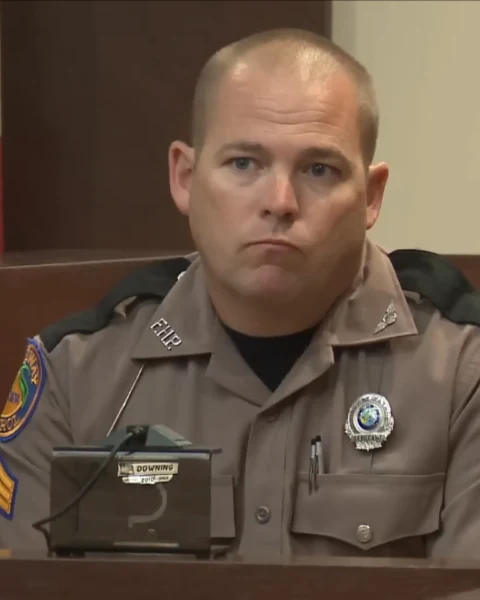
Courtroom still of Stephen Downing.

Florida Highway Patrol trooper, later sergeant, who wrote the June 4, 2014 speeding citation to Luis Rivera and testified about it for Sigfredo Garcia's defense.

78 lines·12 proceedings·9 mentions·2 trials

About

Downing is the officer of record for a documented, dated point along Luis Rivera's route, and his testimony marks out precisely what that record can and cannot support: it fixes the vehicle, the driver, the speed, and the time, but not whether anyone was riding with Rivera and not whether video of the stop still existed. That distinction between a preserved document and lost or never-created corroboration is why his appearance matters to the case record.

Stephen Downing was a Florida Highway Patrol trooper — a sergeant by the time he testified — whose connection to the case rests on a single traffic stop: the June 4, 2014 citation he issued to Luis Rivera, identified by license in a four-door Hyundai clocked at 90 mph in a 70 mph zone. Called by Sigfredo Garcia's defense in the Garcia–Magbanua 2019 trial, he took the stand on the eighth trial day through direct, cross, and redirect examination. His appearance had been arranged days earlier in a bench discussion over a scheduling conflict and a related dispute about two Florida Highway Patrol protocol documents produced in amended discovery, which the court agreed to take up at a Richardson hearing. On the stand he described his training in detecting impairment, the agency's practice of activating dash cameras with emergency lights, and the roughly 30-day retention window for non-criminal footage, while confirming he had no independent recollection of Rivera or the stop after writing thousands of citations. The most closely examined point was the citation's passenger field, which he explained defaults to "no" unless a number is entered and which he does not individually check — an explanation set against language from his 2018 deposition and left unresolved. What remained after all three phases of questioning was the citation itself, a contemporaneous record of the stop that was later invoked in argument about the drive north and Rivera's condition.

Trial Record (12)

GMGarcia–MagbanuaSep 26, 2019 – Oct 11, 2019Called by defense

Florida Highway Patrol sergeant called by Garcia's defense on the eighth trial day about a June 4, 2014 speeding citation he wrote to Luis Rivera in Wakulla County; he had no independent memory of the stop and testified mainly to FHP practice, DUI-detection training, and the limits of what the citation recorded.

Day 1

OpeningOpening Statement - Saam ZangenehMentioned

Summary

Defense attorney Saam Zangeneh attacked Luis Rivera's credibility as a coached, incentivized cooperating witness, argued Rivera was the actual shooter acting through his Latin Kings network, and offered an alternative theory that Rivera was Charlie Adelson's drug supplier who solicited the murder directly — leaving Garcia as a peripheral figure whose only connection to the crime is Rivera's tainted account.

Mentioned in this proceeding.

Day 6

ProceduralFHP Protocol Discovery Dispute and SchedulingMentioned

Summary

Defense moved to exclude two FHP protocol documents disclosed that morning as amended discovery, and Judge Hankinson agreed to hold a Richardson hearing; the court also resolved Trooper Downing's Monday scheduling conflict.

Mentioned · Subpoenaed defense witness (FHP) with a Monday scheduling conflict; both defense teams had put the State on notice

Day 8

ProceduralState Rests and Judgments of AcquittalMentioned

Summary

The prosecution formally rested its case-in-chief; both Garcia and Magbanua moved for judgment of acquittal on all counts; the court denied both motions; and the jury was informed the defense case would begin.

Mentioned in this proceeding.

DirectStephen DowningSaam Zangeneh4highlights54lines spoken

Summary

Garcia's defense used Downing's June 2014 citation and qualified answers to a cocaine-impairment hypothetical to challenge Rivera's account; the proceeding did not establish that Rivera had consumed five grams before that stop.

Highlights (4)

procedural actionThe citation showed that Downing identified Rivera by license while driving a four-door Hyundai and cited him for 90 mph in a 70 mph zone. Downing estimated an average stop at three to five minutes; he did not independently remember this stop.Open in transcript →Watch this moment ▶
testimony highlightZangeneh asked whether five grams of cocaine over five hours should produce substantial signs; Downing, who could not quantify five grams, answered 'Should be, yes.' He agreed traces could be present and said evidently none were recorded in connection with the citation.Open in transcript →Watch this moment ▶
Quote“Should be, yes.”— Stephen DowningDowning agreed, in qualified terms, that Zangeneh's five-gram hypothetical should produce substantial signs. He had just said he could not quantify five grams.Open in transcript →Watch this moment ▶
Quote“Evidently not. It was nothing else.”— Stephen DowningDowning said the citation reflected no further event. The exchange addressed possible visible traces; it did not establish a search for paraphernalia or an independent memory of Rivera's condition.Open in transcript →Watch this moment ▶
CrossStephen DowningGeorgia Cappleman4highlights17lines spoken

Summary

Cappleman established that Downing had no memory of Rivera or the stop, believed non-criminal dash-camera footage was retained for 30 days, and could not use the citation's default field to establish whether an ordinary passenger was present.

Highlights (4)

Quote“I believe on a non-criminal case it's 30 days.”— Stephen DowningDowning stated his belief that non-criminal dash-camera footage had a 30-day retention period and agreed it would not be obtainable when the stop became relevant years later. He did not independently verify deletion of this specific recording.Open in transcript →Watch this moment ▶
testimony highlightDowning confirmed he has no independent recollection of the traffic stop, no memory of issuing the citation, and cannot picture the person he stopped — having written thousands of citations since June 2014.Open in transcript →Watch this moment ▶
Quote“Basically it defaults to no unless we put a passenger number in there.”— Stephen DowningDowning explained that the field defaulted to 'no' without affirmative entry, so it did not establish whether an ordinary passenger was present.Open in transcript →Watch this moment ▶
evidence eventCappleman used State's 191 and 192, marked for identification, to examine the electronic citation field. Downing said it defaulted to 'no' unless a number was entered and agreed the manual's 'yes' category concerned a 16-passenger vehicle.Open in transcript →Watch this moment ▶
RedirectStephen DowningSaam Zangeneh3highlights7lines spoken

Summary

Downing repeated that the citation field defaulted to 'no' and could omit actual passengers, then confirmed a 2018 deposition passage discussing the displayed notation; the record did not establish whether Rivera had a passenger.

Highlights (3)

testimony highlightDowning explained that the field defaulted to 'no,' was not required for citation submission, and could remain unchanged even when passengers were present.Open in transcript →Watch this moment ▶
Quote“It would always default to no. It's not something that we have to — it's not something we're required to do on a citation as far as before it lets us submit it.”— Stephen DowningDowning confirmed that the field populated automatically and was not required for submission, limiting any inference about ordinary passenger occupancy.Open in transcript →Watch this moment ▶
impeachmentZangeneh read a September 2018 deposition passage in which Downing inspected the citation and discussed the 'no passengers' display. Downing confirmed recalling that answer; the passage did not clearly establish an affirmative entry.Open in transcript →Watch this moment ▶

Day 10

ClosingClosing Argument - Saam ZangenehMentioned

Summary

Garcia's lead counsel Saam Zangeneh delivered a systematic credibility attack on Luis Rivera using a 'house inspection' metaphor, argued Rivera was the actual shooter, and told jurors the evidence pointed more substantially at the uncharged Adelson family than at Garcia.

Mentioned in this proceeding.

KMMagbanua RetrialMay 18, 2022 – May 27, 2022

Florida Highway Patrol trooper subpoenaed as a defense witness who never testified after a mid-trial dispute arose over whether his long-consistent account — that Luis Rivera was alone in his car during a traffic stop — had changed following a conversation with a prosecutor.

Day 3

CrossWaldo Mesa NunezTara KawassMentioned

Summary

Kawass establishes that Nunez lacks independent memory of the June 2014 renter, clarifies that the contract time was a due-back time rather than the second arrival time, and elicits that he cannot explain why Officer Downing made particular citation entries.

Mentioned in this proceeding.

Day 5

ProceduralMidmorning Recess and Trooper Downing Logistics NoteMentioned

Summary

Judge Wheeler calls a 15-minute midmorning recess; defense counsel flags that subpoenaed FHP Trooper Downing has not responded and asks prosecution to assist with contact.

Mentioned · Defense witness subpoenaed in April; has not responded to email or calls to his barracks; defense requests prosecution provide a direct contact number

Day 6

Day 7