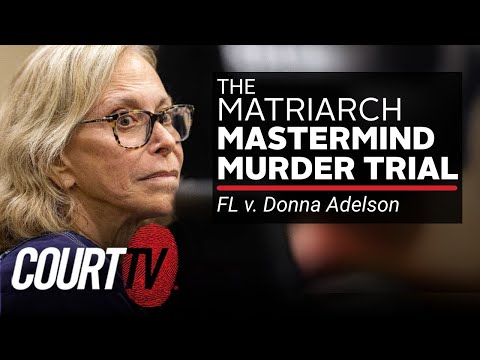
Judge Everett denied the defense motion for judgment of acquittal and the defense opened its case in chief with character witnesses and a digital forensics expert. A recalled character witness's explanation for the absence of a murder-night phone call to Donna Adelson collapsed when the prosecution established that WhatsApp did not support voice calls until nine months after the July 2014 murder.
Full day summary
Day 7 opened with the defense moving for judgment of acquittal on counts one (principal to first-degree murder) and three (conspiracy) at the close of the state's case. Defense counsel Zelman argued under Denise Williams v. State, 314 So. 3d 775 (First DCA 2021) that principal liability requires proof of what Donna Adelson specifically did on the day of the crime, and that the record showed no direct communication between Donna and any person who carried out the murder. Prosecutor Dugan responded by cataloging the bump video statement in which Donna told Charlie "it involves both of us," Katherine Magbanua's testimony about washed money, the 2014 planner containing Markel's vehicle information, 44 signed checks to Magbanua, and evidence the prosecution characterized as consciousness of guilt, including a one-way trip to Vietnam after Charlie's verdict. Judge Everett pressed the defense on the Williams comparison, noting the record also contained an alleged confession, suborning perjury, and flight — evidence absent from Williams. He denied the motion.
The defense case opened with Ann Elizabeth Cunningham, a close friend of Donna's who testified that on July 18, 2014, Donna called her crying and hysterical, said Danny had been shot, expressed concern for Wendi and the boys' safety, and told Cunningham she did not know who shot him. Prosecutor Cappleman's cross established that Cunningham sent Donna an all-caps "I know you are ALL innocent" text after Charlie's conviction, had watched Charlie's trial from her own home alongside Donna, and acknowledged the jury reached that conviction correctly — or incorrectly, in Cunningham's framing. Cappleman also established that Donna's Vietnam trip used a one-way ticket to a non-extradition country, and that Cunningham's interpretation of Donna's "hoping to make it out of the airport" statement was that Donna meant the plane would be on time.
Defense digital forensics expert Kelsey Guay testified that the prosecution's count of 417 Charlie-Donna communication events for May–July 2014 was inflated because the tool failed to deduplicate AT&T's multi-row call encoding; her manual recount yielded 383 to 393 depending on methodology, and 211 using Donna's records alone. More significantly, Guay testified that Donna's handset never connected to a cell tower capable of covering Charlie's residence on July 18, 2014, and that the two phones never shared a tower that day. On cross, Dugan established that Guay's own records showed no phone call between Donna Adelson and Ann Cunningham on the evening of July 18, 2014, and that Donna was making and receiving ordinary voice calls with others that night — a point that became central in subsequent proceedings.
After lunch, defense recalled Cunningham to testify that she and Donna typically communicated via WhatsApp or Viber rather than standard cell calls, which would explain the absent CDR entry. Cappleman's cross reduced that testimony to rubble in a single question: WhatsApp did not offer voice calls until March 2015, nine months after the murder. Cunningham immediately substituted Viber under oath. Cappleman closed with "Huh. Nothing further." Defense declined redirect.
Character witnesses Ron Gutterson and Richard Shagran testified about the Adelsons' intent to return from Vietnam for a grandson's bar mitzvah. Cappleman secured Gutterson's acknowledgment that a murder arrest warrant would be an "abnormal circumstance" that might prevent return. Shagran provided an innocent explanation for the one-way ticket — he suggested it because round trip was only fractionally more expensive and the return date was uncertain — though Cappleman used his deposition to establish he had described himself as "the conduit for the technology," not a decision-maker. Cappleman also confronted Shagran's "ultimate Jewish mother" character portrait with a reference to alleged conduct involving Nazi uniforms.
Defense private investigators Tarana Khan and Eddie Varnes each testified about separate jail interviews with prosecution jailhouse informant Patricia Byrd, denying she reported any inducements from the Adelson side or described a confession by Donna. Dugan's cross of Varnes elicited the full text of the Magbanua quote Byrd allegedly shared — "After we had him killed, we tried to get the money" — while establishing neither investigator had recorded their interviews and neither counsel had listed Byrd as a defense witness.
Defense called Leon County Detective Josh Turner to authenticate jail surveillance video from December 19, 2024, showing jailhouse informant Drina Bernhardt and Donna Adelson together in the pod. Cappleman's cross converted Turner into a prosecution witness: he confirmed Bernhardt disclosed the day before that Adelson had tried to enlist her to deliver perjured testimony, that the scheme required Bernhardt to copy a script in her own handwriting and return the original to Adelson, and that the jail video corroborated everything Bernhardt told investigators. Redirect drew Turner's concession that the video is inaudible and all interpretation of the session depends entirely on Bernhardt's account.
A sequestration violation involving realtor Tim Kelly — who had been seated in the gallery during defense testimony — prompted a bench inquiry, a ten-minute recess, and an end-of-day admonition from Judge Everett directed at defense counsel by name. Kelly's brief testimony concerned a 2011 home-showing tour for Donna and Harvey Adelson arranged at Dan Markel's request, which the prosecution used on cross to anchor the Adelsons' expressed interest in Tallahassee to the period before the divorce.