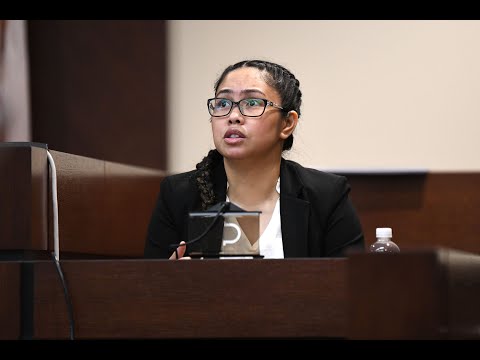
Defense cross-examination drew concessions from cell-site analyst Corbitt that his analysis cannot confirm Rivera and Magbanua ever met on July 19 and that a potential alternative phone-holder was never investigated. Witness Mascaro fixed her babysitting night to July 18 via Instagram, placing Magbanua's description of the murder as a "car accident" on the morning it occurred. Judge Wheeler closed the day by excluding all remaining jail recordings and excluding the Kawass-Garcia calls as attorney work product.
Full day summary
Day 4 opened with two pre-testimony disputes. Judge Wheeler addressed approximately 15 recorded jailhouse calls between defense attorney Kawass and Sigfredo Garcia, reserving ruling on Kawass's work product claim pending research and a Richardson hearing once Spanish-language calls were translated. A separate dispute over an Apple account document linking phone number 934-6615 to Luis Rivera was resolved against the defense: Wheeler credited the prosecution's officer-of-the-court representation that the document had been produced in 2016, finding no discovery violation, and ordered the prosecution to supply any underlying court order by lunchtime.
The morning session centered on Christopher Corbitt's extended cross-examination. DeCoste established the methodological ceiling of CDR analysis — include/exclude assessments only, no GPS precision, no radio-frequency mapping for Miami cell sites — then challenged the prosecution's June-trip inferences as resting on an "assumption based on an assumption" when Corbitt conceded the rental car return date was unknown. Defense exhibits covering an unremarkable May 2014 date showed the same Garcia-Adelson-Magbanua communication pattern the prosecution highlighted on "significant" dates. Most consequentially, Corbitt conceded his analysis cannot confirm whether Magbanua and Rivera ever physically met on the morning of July 19, and acknowledged for the first time in any sworn proceeding that he had recently heard the theory that Anthony Ortiz — a Rivera associate never interviewed and never subjected to CDR analysis — may have possessed Rivera's 8153 handset that morning. On redirect, Dugan introduced three iCloud exhibits from Charlie Adelson's account, including Magbanua's July 2 outburst calling Garcia a profane epithet for leaving messages — linked to Garcia's July 1 voicemail to Harvey Adelson — and an exchange confirming no direct Garcia-Adelson call was documented in the phone records.
Before the lunch recess the prosecution played State's Exhibit 133, a recorded conversation in which a speaker denies knowing Garcia had contacted Adelson and is asked directly whether Garcia knew Charlie Adelson was paying for the murder. Judge Wheeler subsequently rejected a defense rule-of-completeness argument that the excerpt opened the door to the full prior trial transcript.
The afternoon focused on Magbanua's financial and social context. Childhood friend Yindra Velazquez Mascaro described Garcia's jealousy toward Adelson, Adelson's gift of a used Lexus to Magbanua while she was back with Garcia, and testified that the morning after the murder Magbanua told her Adelson's brother-in-law had been in a car accident. Defense cross established that Mascaro could not pinpoint the date beyond sometime in July, that the Lexus was a 2001 model with over 150,000 miles, and that the police interview report had misstated Mascaro's statement about who paid for a breast augmentation. On redirect Mascaro disclosed an Instagram photo from the babysitting night; recalled after the afternoon recess, she confirmed the date as July 18, 2014 — fixing Magbanua's "car accident" framing to the morning of July 19, the day Markel was shot.
Club Fate owner Ramzi Naber described Magbanua's roughly three-month tenure as a cocktail server averaging $200–$250 per night, with all employment records destroyed in a hurricane flood. Defense elicited that cash tips from cash-paying patrons were invisible to management; prosecution rehabilitated the estimate on redirect by establishing 90 percent of the club's business ran on credit cards.
June Umchinda, who dated Charlie Adelson for approximately two years, testified he kept thousands of dollars in hundred-dollar bills inside a bedroom safe and that after Garcia and Rivera's arrests his demeanor deteriorated significantly. Cross-examination established that Adelson lied to Umchinda about his whereabouts the night he met with Magbanua, instructed her not to answer the door if police arrived, and that FBI agents secretly recorded an interview after promising confidentiality.
Long-serving Adelson Institute employees Clariza Lebredo and Erika Johnson each testified they never saw Magbanua working at the practice during 2014–2016. Johnson testified that when FBI agents arrived seeking Magbanua's employment records she called Charlie Adelson rather than Donna or Harvey, and authenticated the intercepted call as State's Exhibit 100. Cross drew out a 2017 sworn statement in which Johnson had expressed uncertainty about whether Magbanua was ever an employee. Redirect foreclosed a defense inference that Magbanua could have worked Fridays when Johnson was absent, by establishing the office does not schedule patients on Fridays.
Wheeler closed the day with four rulings: the Kawass-Garcia calls were excluded as attorney work product; Spanish-language calls were excluded because their content was unknown and mid-trial transcription would unfairly burden the defense; English-language calls were admitted for impeachment purposes only; and all future jail recordings were prospectively barred from admission. A Crawford hearing was scheduled before any recorded Adelson family calls could be played to the jury.