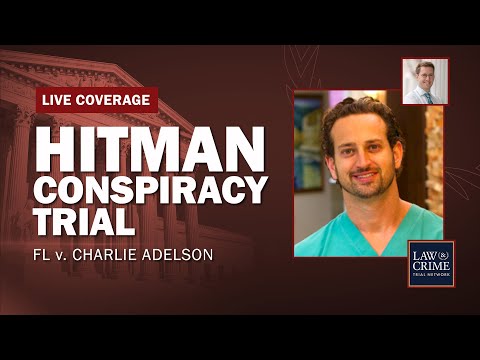
Katherine Magbanua took the stand as a convicted co-defendant, admitted lying at both her prior trials, and named Charlie Adelson as the originator of the murder-for-hire plot. The day also featured the completion of Luis Rivera's cross-examination, corroborating testimony from two Adelson Institute employees, a comprehensive forensic accounting presentation by Mary Hull, and the beginning of cell-site analyst Sgt. Christopher Corbitt's testimony, which carried over to Day 4.
Full day summary
Day 3 opened with the conclusion of Luis Rivera's testimony. On cross, Dan Rashbaum elicited Rivera's characterizations of Katherine Magbanua as "the mastermind" who was "running the shots," established that Rivera had no direct contact with any Adelson family member, challenged the reliability of the "I know" testimony on grounds that Rivera was driving on a highway with an open window and that he reportedly told law enforcement in 2016 he had not heard the comment, and advanced the defense's alternative theory that Garcia and Magbanua may have been extorting Charlie Adelson rather than acting on his commission — to which Rivera answered "I don't know." On redirect, Georgia Cappleman addressed Garcia's post-murder spending pattern and had Rivera confirm he said nothing about "the dentist" during the actual Tallahassee murder trips, separating Garcia's personal jealousy from the operational context.
The day's central testimony came from Katherine Magbanua, a convicted co-defendant serving life for the murder. On direct, she admitted under oath that she had not been truthful when she testified at her own murder trial and that her prior defense was false. She testified that Charlie Adelson first raised the idea of harming someone at a Halloween 2013 party in Miami, asking whether she knew anyone who could "harm someone." She described the conspiracy's mechanics: Charlie provided target information in a sealed manila envelope he handled with gloves, sealed without licking, and printed outside his office to avoid fingerprint and DNA traces; she relayed the envelope to Sigfredo Garcia. On the night of the murder she went to Charlie's home and found him frantic, holding a gun. The following morning she received pre-packaged cash in Ziploc and grocery bags, described as damp, which she then delivered to Garcia. She denied every element of the defense's extortion theory. The prosecution introduced and published a code-word chart she authenticated.
On cross, Rashbaum walked Magbanua through specific sworn denials from both prior trials, extracting repeated flat admissions of perjury. He established through proffer transcripts that she minimized her role for roughly the first hour of her initial post-conviction interview, and that Special Agent Sanford documented frustration and left the room during a second session. He introduced Defense Exhibit 34 — text messages he argued showed Charlie did not know about Magbanua's ex until at least November 27, 2013, a month after the Halloween date she had cited as the conspiracy's genesis. He also noted she never told Charlie to stop making a "TV is cheaper than a hitman" joke despite the alleged active conspiracy. The cross concluded with Magbanua acknowledging that she hopes the state will help her — "Of course. I want to see my children again." On redirect, Cappleman clarified that Defense Exhibit 34 showed Garcia learning of Charlie in November, not the reverse, and had Magbanua confirm the job was to kill and that Charlie understood it was murder.
Two Adelson Institute employees provided corroborating testimony. Dental assistant Clariza Lebredo, with nearly 40 years at the practice, confirmed Magbanua was never an employee — only a patient seen two or three times — that advance paychecks were issued only for family vacations at a maximum of two checks at a time, and that no employee ever worked exclusively by phone. The defense waived cross. Front-desk employee Erika Johnson corroborated Lebredo and was the vehicle for State's Exhibit 106, a recorded June 1, 2016 phone call she made to Charlie when law enforcement arrived seeking Magbanua's employment records. In the recording Charlie told her "I would not speak to anybody," repeatedly characterized the office as "my dad's office," and ended the call by saying he would phone back from a landline — a detail treated in the record as evidence of awareness that his cell calls were under surveillance. On cross, Rashbaum elicited that Charlie did not own the office at that time and that Johnson loved working with him. On redirect, Dugan established that Charlie continued working at the practice regardless of formal ownership, and that Johnson had no recollection of what was said during the landline callback.
Forensic accountant Mary Hull, admitted without objection as an expert in forensic accounting, presented a comprehensive financial picture. For Rivera she documented a chronic overdraft pattern that ceased for approximately four months after the murder then resumed, consistent with a one-time outside cash source. For Magbanua she showed $17,300 deposited in the six weeks following the murder and $46,820 for the full murder year — roughly three times the prior year, with cash comprising 64% of her total income. The Adelson Institute produced only a QuickBooks printout in response to a subpoena, with no W-2, timesheet, or employment application; three final checks to Magbanua did not appear on it at all, and payments stopped after Garcia's arrest. Harvey Adelson's Lexus was transferred to Magbanua for a stated $1,700 with no traceable payment. iCloud messages showed Donna Adelson directing movement of $25,000 in cash between personal piles in a family safe. On cross, Rashbaum elicited Hull's concession that the "murder" label on her charts was not a scientific designation and could equally read "extortion," and that a $3,000-per-month regular payment arrangement would not surprise her. On redirect, Dugan established that Magbanua's cash deposits were irregular across multiple accounts in small amounts — not a clean monthly sum — and that the iCloud messages showed Magbanua requesting cash from Charlie in a friendly rather than threatening tone.
Sergeant Corey Hale testified briefly to rebut a defense timeliness challenge to prior witness Jeffrey Lacasse, confirming that Lacasse reported the "celebration dinner" remark on August 12, 2014 — about a week after receiving the information — not in March 2015. He also confirmed Lacasse had been fully cleared as a suspect. On cross, Rashbaum built a portrait of Lacasse as an obsessive ex-boyfriend, established the "celebration dinner" claim as double-hearsay, and secured Hale's concession that a "too scared" explanation for delayed disclosure would have been inaccurate.
The day closed with the beginning of cell-site analyst Sgt. Christopher Corbitt's direct examination, which continued into Day 4. Corbitt described how a tower dump at Premier Gym, cross-referenced against Adelson family contacts, identified Garcia through a single 37-second call to Harvey Adelson. He traced Magbanua's cell sites to the car-rental location on June 2, 2014 — the first surveillance trip vehicle pickup — followed by a 25-minute call to Charlie, which Charlie relayed in an immediate 25-minute call to his parents' landline. Corbitt established that Charlie made only 28 calls to the Adelson residence landline over nearly two years, and four of those clustered on the two car-rental nights. He read an iCloud message in which Donna Adelson asked Charlie to "erase this text after you read it." Garcia's phone went dark after the murder at 9:58 a.m. and reappeared north of Gainesville at 12:30 p.m., with Garcia's first call upon powering back on going to Magbanua. Post-murder iCloud messages showed Charlie and Magbanua discussing ordinary topics with no reference to blackmail or extortion.