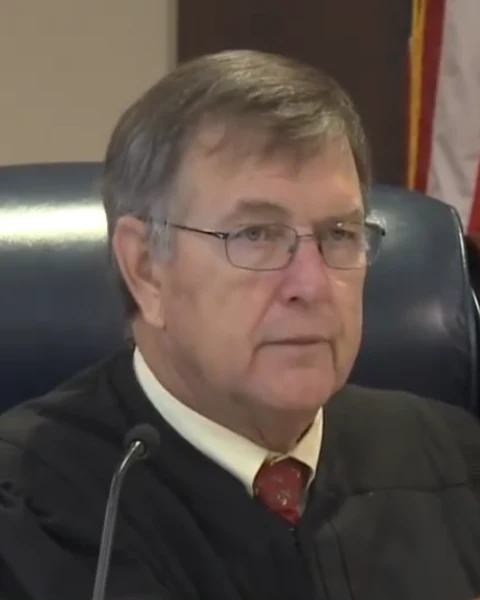
Presided over the joint trial of Sigfredo Garcia and Katherine Magbanua across all eleven trial days, setting courtroom conduct and sequestration ground rules at the outset and carrying the trial through evidentiary rulings, jury instructions, deliberation questions, verdict-taking, and post-verdict logistics.
James C. Hankinson

Judge who presided over the joint Garcia–Magbanua trial, ruling on evidence and instructions and overseeing deliberations, Garcia’s verdict, and Magbanua’s mistrial.
About
Presiding over the joint trial of Sigfredo Garcia and Katherine Magbanua in Leon County Circuit Court, the court opened with trial-procedure and sequestration rulings on day one and issued conduct directives requiring parties to refer to persons by title and surname or full name and to state objections by legal ground without argument. The rule of sequestration was revisited later in the trial, with the court confirming that all parties had been reminded to inform their witnesses of it.
Evidentiary management ran through the examinations of both sides' witnesses. During the State's case the court gave the jury an unprompted explanation of Florida's certified business-record statute, clarifying why rental-agency, phone-carrier, and Facebook records were admissible without live custodians, in response to a running pattern of defense hearsay and foundation objections. On the hearsay question raised by a defendant's own out-of-court statements, the court explained the asymmetry: such statements are admissible when offered against the defendant as party admissions but remain hearsay without an exception when the defendant offers them in her own favor. Later rulings admitted Exhibits 15 and 16 over the State's hearsay objection while sustaining the objection to the loan-repayment texts in Exhibits 17 and 18, which were made part of the record but not sent to the jury.
A discovery dispute over a traffic citation drew a Richardson inquiry. The court first committed to holding the hearing at the appropriate time without immediately ruling on exclusion, then denied the motion to exclude — finding no willful concealment because the ticket was named on the evidence list, a six-day disclosure lag that was mildly but not substantially tardy, and no cognizable prejudice five years after the fact — clearing State's Exhibit 122 for presentation. The exhibit was formally admitted on redirect, with the defense expressly allowed recross on that issue. On recorded-call evidence, the court instructed the jury that the recordings are the evidence and the transcripts are aids only, that the recording controls where the two differ, and confirmed transcripts were collected after each call and would not go to the jury room; as to the Dolce Vita recording, the transcript was excluded and the court stated it had been unable to match the transcript to the audio even using headsets. The court also voiced frustration during argument on prior bad acts that the State's objection was as generic as the defense's questions and that neither party had helped draw a workable line between admissible federal-plea conduct and inadmissible unrelated bad acts, and directed defense counsel at a mid-examination break to pre-clear planned exhibits with the State during the recess because stopping to present documents was disrupting the examination. One recess was called without a ruling on a pending objection or the renewed severance motion.
Scheduling and instruction work included flagging that a charge conference with all attorneys would be necessary before jury instructions, a scheduling and lesser-included-offense discussion on day four, and a closing session in which the court confirmed counsel had reviewed the verdict forms, directed them finalized and copied, and adjourned to 8:30 the next morning.
During deliberations the court fielded several jury questions. On whether a principal to first-degree premeditated murder must personally form premeditated intent, the court directed jurors to the instruction definitions of premeditated murder (pages two and three), principals (pages five and six), and independent act (pages six and seven), declined to answer the question as a hypothetical, and offered to clarify confusion about the definitions themselves. It ruled that the law of principals does not apply to the conspiracy count, overruling the State's objection that no such exclusion exists. Asked whether a hung jury on one defendant or one count permitted a verdict on the other, the court answered yes to both and referred jurors to the multiple-counts and multiple-defendants instruction on page 13; on a further principal-doctrine question it sent a written response confirming there are no exceptions or exemptions to principal liability while asking the jury to clarify the remainder before answering. The court authorized the clerk to deliver all physical evidence to the jury and confirmed technical assistance was available. Addressing the prospect of deadlock, it stated that a jury may lawfully agree on a verdict or disagree on the facts but that the law as instructed is not open to disagreement, with residual legal confusion to be referred to the court, and said it would declare the case mistried and discharge the jurors if no verdict followed the directed exercise. Over the parties' conditional positions, the court ruled it would accept the verdict on whichever defendant the jury decided and give an Allen charge as to the hung defendant regardless of which one, directing both defendants to remain seated when the jury entered. After unanimous polling confirmation, the court directed the verdict filed, and on day eleven took up Garcia sentencing jury logistics.
Trial Record (193)
No proceedings match this filter.